Saturday, May 11, 2013

Mountain Juggles

As far as I could tell, I had been juggling a lot since I joined the juggling club at the university here. They are pretty intense about getting a lot of hours of practice in, and even the small fraction of that in which I participate is about 4 times as much as I juggled back in the states. However, a week ago my definition of "juggling a lot" was blown to bits after ascending into the mountains of Japan for a 3-day juggling extravaganza.

This mountainous juggling adventure was the juggling club's spring retreat, known more commonly in Japan as a "gashuku" (合宿). Almost every club in Japan has a gashuku at some point or another, and they can range from anything to completely social trips, to training camps. The one which I attended is probably described best as a healthy combination of both, with an extra dash of training camp.

The trip started off at 7am on a Friday morning, with a 6 hour bus ride out of Tokyo and into the mountains. That may sound like some far off venture, but actually in Japan, if you are not on a coast, then there is probably an 80% chance you are in the mountains. We got the got off the bus, dropped stuff off in the hotel rooms, and then immediately proceeded to a nearby gym for a few hours of practice. Each day was similarly structured: Wake up. Eat. Juggle. Eat. Juggle. Eat. Socialize (Juggle). Sleep. Despite the large portion of time each day taken up by juggling practice, the gashuku gave a lot of opportunities to hang out with people in a different context than usual, and to be social with people outside of the usual juggle-centric practices, and despite being absolutely exhausted upon returning at 10pm three nights later, it was a fantastic trip. For a bit more detail into what happened on the retreat, take a look at the pictures below.

Arrival on the mountainside.

One of the several tables in the dining hall in the inn.

One of the three different gyms that we practiced at while we were there. This probably about a third of the group, most people were still getting ready.

Juggling! Wheeeeeeee!

The tallest game of Jenga that I have ever seen.

One evening I learned how to play Go, an ancient Chinese strategy game that looks deceptively simple, but makes Chess look like tic-tac-toe.

Final group shot in front of the inn, just before returning back to Tokyo.

Thursday, May 2, 2013

Golden Week Streets

Yesterday began what is known as Golden Week, a week at the beginning of Spring in which Japan has 4 national holidays in rapid succession, and many organizations just take a break during the days in between each holiday, resulting in a week long vacation for almost the entirety of the country. While many people are going off on adventurous travel plans, I'm staying right here in Tokyo, and started off my Golden Week celebrations in the neighborhood of Koenji.

The best performance of the day. Note the small squadron
of astounded children nearby. They were messing
with him throughout the entire performance,
 and he took it as a chance to make things a bit more fun.
Koenji (高円寺) is a convenient train hop away from where I'm living, and a really interesting area of tiny shops and restaurants. However, what drew me there for the first time Sunday was Bikkuri Daidogei (びっくり大道芸), a huge street performance festival that sprawls throughout the area. There were performance of every variety, from musicians to jugglers to magicians and back again. It was a beautiful day and I could have enjoyed simply strolling through the neighborhood regardless of the various squads of performers there to ensure that I was having a good time. The most notable act of the day was a performer who first seemed to be a mime of sorts, but ended up also being an absolutely incredible juggler. Not only was he incredibly skilled, but he was playing with kids from the audience the entire time (not to mention a few grown-ups), and really knew how to sympathize with the crowd and draw their energy to his performance. As much as I've been able to grow technically as a juggler here, it was a very refreshing reminder that ultimately good performing has little to do with the skills you show on stage, but so much more to do with connecting to the audience, and enabling them to feel the excitement along with you.

Needless to say, the street festival has been the highlight of my Golden Week thus far. Other than that, I've been keeping myself busy staying social around Tokyo, seeing friends, playing in the park, all of the good stuff that one should be doing during a week off in the spring. Tomorrow morning I'm off for a retreat with the juggling club, and so will be rounding off this Golden Week with a nice-and-shiny, 3-day juggling jamboree. Until then, よろしく!

A walking, metallic, bird on stilts....Don't ask questions.

A brass band playing every kind of tune you can imagine. 
A diabolo artist who did all of his routines to the tune of an audience-member-driven street organ.

Wednesday, April 17, 2013

The Most Wonderful Time of the Year


Many of you have probably seen this commercial, representing the gleeful frolic of parents preparing to send their children off to school again, and kids sad at the prospect of once again facing the perpetual, existential monotony known as public education.

For me, this is the complete opposite. I love school (and my mom hated when I went back, because that meant I got super busy and never saw her [or anyone else for that matter] ever again until the next break). And although the school system here has led to a much different starting time, I am indeed very excited to be back in school once again.

Here's a question I never quite understood the answer too: Why do you like not being in school? In school you see your friends EVERY DAY. Without even having to try to hunt them down or make plans! They just show up! (usually). Yea, I mean there's work too...but I'm happy to do work and have a social life every day than be bored.

As per usual procedure, I was really excited to be consistently seeing people again. There were a lot of friends here who I haven't seen in weeks (or months). Apart from the general merriment of social reunion, what's been particularly interesting is hearing all of the stories from what other people were doing while I was in Hakuba. From the sound of it, almost everybody had a moving experience in one way or another, and having a shiny new experience to share with everybody is refreshing.

But of course, there is indeed the whole "academic" aspect of school to be dealt with as well. After last term, I learned not to make the mistake of picking classes with a potentially-awesome syllabus, but instead asking people and choosing courses with verified-awesome teachers. And luckily for me, one such teacher is a mime. That's right, a mime. He's an adjunct professor who teaches on the side of performing professionally all over Japan, and this term he is teaching a class about the history and development of mime and pantomime (is there difference? I guess we'll find out!) At any rate, that class is going to be FANTASTIC. The only other non-Japanese class I'm taking is Web Programming, which so far has been pretty simple, but will become more interesting in the coming months.

So, one week into classes things are going well so far at Waseda. People are beginning to settle into their course schedules, and routines are being reestablished (on that note, blogs should be coming forth more reliably from now on, sorry about that!). And with that: onward we go!

Monday, March 25, 2013

Small Graduates, Big Ceremony

Guess I had some good timing with the year I came to Japan, because today I had the opportunity to go to my host brother's graduation.

From elementary school.

I can't even remember if I had a ceremony for graduation from elementary school. Regardless, I was sort of expecting something fairly low key, maybe a few little speeches, people would get certificates, and so on. However, I knew that it had to be something more intense when my host sister suggested that I wear a suit and tie for the occasion.

The nice, big, healthily funded elementary school.
For starters, i'm fairly convinced that the elementary was bigger than my middle school (which can likely to be attributed to the fact that people and governments care about education in Japan). It's nestled in a neighborhood, and easily the nicest building to be found in the immediate vicinity. Not to mention, they have roughly 30 unicycles that people can use during recess!....okay, so I'm jealous.

So we arrived at the elementary school this morning and my host family and I walked to the gymnasium and took our seats to wait for the ceremony to begin. The gym was split into several sections, one for parents, one for teachers, and two for students, with a stage at the front and various percussion instruments along one side. Other than the parents section it was empty. Almost all of the other parents were also wearing suits, with the only exception being an occasional kimono sticking out in the crowd.

The ceremony began exactly on schedule with a voice over the intercom thanking everybody for coming, and announcing the entry of the teachers. All of the teachers from the school entered in a single file line, and bowed to the families before taking their seats. After them, the students from the 5th grade class came entered (in Japan elementary school goes up to 6th grade), most of them with a recorder in one hand, and melodica in the other. (At this point I'm thinking "Everybody gets a melodica and unicycle? Why didn't I go to this school!?)

After entering in the quietest line of 5th graders I've ever seen, some of them moved over to the percussion instruments, and one of the teachers stood up, revealed herself as the music teacher by striking a conductor's position, and began leading the group of students into a tune.

Now, I'm sure many of you have had the experience of attending an 5th or 6th grade music concert, and for that I am terribly sorry. It's no secret that these concerts generally are of the quality that one would expect from a group of 10 year old kids.

Because of that, you'll understand my surprised when upon the conductor's signal the resulting sound was not a squeal of instrumental jabber. It was actually music. Heck, it was pretty good! All of the kids were on the same rhythm, playing the right notes, following the conductors changes. I, for one, was impressed.

And with the start of the music also began the progression of graduates into the gym. All of the 6th graders were wearing suits or skirts, and filed in single file to find their seat near the stage. Once everyone had entered the principal of the school went to the center of the stage and immediately began calling out names to receive their diplomas. Each of the students received their diploma and left stage in exactly the same, clean format: bow, grab the diploma with the left hand, then right, hold it out while you bow once more. Bend the diploma in half and hold it by your left side, turn and walk off stage. The uniformity of the pageantry was pretty remarkable. Following the diplomas the principal then addressed all of the students, talking about how as they grow into adulthood they can be the ones to help solve the world's problems, and how they need to continue working hard to accomplish their dreams. It was roughly the same nature of the speech we received at my high school graduation, except in Japanese.

My favorite part was what came next. After the principal and a few other teachers gave some speeches. The recent graduates stood and turned to face the audience, and then recounted their elementary story for first grade to present day. While they stood as a crowd, each member said one or two sentences without moving from their spot, creating this effect where you could hear different voices from different parts of the mass of graduates piecing together their collective story. It was really cool.

They then sang a song about continuing toward their dreams while never forgetting the past, to which the 5th graders responded by rising and singing a song thanking them for their guidance as their seniors, and promising to continue to work hard as the followers of their footsteps. (And as before their musical pieces were surprisingly well performed).

Once it was all done, pictures were taken for each of the respective homerooms, and the ceremony was drawn to a close. I'm happy I was able to see it, not only was it a lovely ceremony, but it was definitely different from the way I remember elementary school. The best part though, was that as the graduates filed out, my host brother, diploma in hand, was wearing the biggest smile in the room.

Sunday, March 10, 2013

Tokyo! I'm home!

After a month spent working away at the Hotel La Montagne Furuhata in Hakuba, I finally returned to Tokyo a few days ago. My last post kind of makes it sound awful, and to be honest the beginning was pretty bad. However, as my time there went on things got a lot better, and so I'd like to sum it all up by listing off some of the good things that happened as a direct result of being in Hakuba.

I can now set a table in preparation of breakfast for 20 in under 5 minutes flat

My Japanese has shown noticeable improvement, as shown by several of the juggling members saying "What the hell, you got good at Japanese!" when I got back.

Right now I'm in the best physical shape I've been in since Japan. I think it's a combination of skiing every-other day, eating insanely healthy food for a month, and the fact that functionally the various kinds of work I did all boil down to moving things around all day.

Through much trial and error I have discovered the method to properly skiing, other than just bolting down the hill as fast as possible and praying not to hit a small child.

I made a few friends.

As working progressed it came to be more apparent that my bosses really appreciate the hard work that we put in. At the end of the month they made me a special dinner of my request, plus all of the things they had noticed I liked to eat as a way of saying thank you.

And to wrap it all up: a few pictures of good points for which words don't quite suffice.

There was a crepe shop at the ski slope, and there "special" has pudding, ice-cream, cake, tiramisu,  bananas, chocolate, strawberries and cream. It hurt, but it was delicious.

At one point the snow was really not fit for skiing, so instead I made a friend.

And as always the mountains on the ski slope were gorgeous... 
...but really, they were awesome.

Sunday, February 17, 2013

白馬働き

My lack of recent blog-related activity has been mostly important to a fairly significant development in my schedule. As part of my study abroad program, everybody does what they call a "Cultural Practicum" for a month between February and March, which is just basically something out-of-the-ordinary from regular study abroad life. It can be anything from studying zen in a temple, teaching English in middle schools, or doing recovery work in Tohoku. The practicum that I've selected involves working at an inn for skiers in Hakuba (白馬), Nagano-Prefecture (長野県).

To give a little background, the city of Hakuba is where all of the skiing events were held during the Winter Olympics were held in 1998. Naturally it's a well known place for skiers both within and outside of Japan, and is has a sparkling, luxurious ski resort with all the bells and whistles right near Happone, the main ski area.

Map of Japan, with Hakuba labeled. It's almost directly northwest of Tokyo.

But that's not where I am.

I am working at an inn near the Iwatake Snowfield (岩岳), a sort of second-hand ski slope that's about a 5 minute drive away from Happone. It's functionally in the middle of nowhere (there is only one convenience store within a 2.3 kilometer radius, by Japan standards that's nowhere), and the city of Hakuba itself is pretty small as well.

A picture of the street near my inn. One of the perks of being in the middle of nowhere is the spectacular landscape (granted, I'll take a cityscape any day, but still..)

So what am I doing at a place like this anyway? Working. The basic agreement for this particular Cultural Practicum is that you get to stay at the hotel, go skiing, and eat breakfast and dinner for free. You just have to work for it.

A lot.

On average, my schedule results in about 10 hours of work per day. Every day. No weekends or holidays, just work for each of the 28 days that I'm here. The nice thing is that every day basically follows the exact same routine, so once you get it down it's not too bad (and that that also means that after I finish this blog post you'll know exactly what I'm doing for the next few weeks!).

So here's the routine:

Every morning at sometime between 5:30 and 6:30, we wake up and go start doing breakfast preparations. Along with rooms, the inn also provides breakfast and dinner for all of the guests, so we have to get that all set up. It's not buffet style, it's everybody-eats-exactly-the-same-thing-in-the-same-portions style, so we have to set out all the plates and load them with food. At 7:00 we open up and guests start coming in to eat. Whenever they are all done we cleanup, do as much setting for dinner as possible in the morning, and then eat our own breakfast. At 10:00 we start cleaning rooms, so if we get done with breakfast before 10:00 (we usually are done around 9:00), we get NAP TIME!!! (I never take naps, but here I accept them as a gift from the gods).

10 o'clock is when we start cleaning. This is pretty straightforward: fold up all the beds and sheets and whatnot, collect all the garbage, etc. There are two buildings to the inn: the main building and the annex. I almost always am assigned to cleaning the annex, which is the less-nice of the two buildings. The fun part about that, is that a large portion of our clientele is college kids going on retreats, and of course they always ask for the cheapest rooms. For those of us who clean the annex, that basically means that we have to clean up a college party. Every day. Not fun (but someone's gotta do it).

Whenever we finish cleaning (usually 12:30), we get our big break for the day. The next time they call us in is to prepare for dinner, which usually isn't until around 5:00, so the afternoon is to be enjoyed at our leisure. What does that mean? NAP TIME!!! Alternatively, if for some strange reason you are of the misconception that you have enough energy to not need a nap, the next logical activity is to go skiing. Luckily, I've come to learn how to time it to fit in both skiing and a nap, and so have hit the slopes here a few times. While I may have referred to Iwatake as the "second-hand" ski slope, it is actually a really nice area, and the view is absolutely spectacular.

View from the top of the Iwatake Snowfield.
As mentioned above, after the break we have dinner, which is basically the exact same as breakfast, just with a bit more cleanup. With breakfast me and the other workers just eat by ourselves, but after dinner we eat with the inn owner and his wife. I really enjoy it because in a lot of ways it feels very communal, and it's fantastic Japanese practice. With all of that combined, we usually get off of dinner at some time between 9:00 and 10:00 in the evening, leaving just about enough time to take a bath, maybe hang out a little bit, and then get some sleep before the routine starts over again.

One quick thing to clear up: The "we" I keep referring to isn't the Royal We, I have two roommates with him I do all this work. I'm literally with them 24/7, unless I decide to go off and do my own thing during the break. Fortunately, they're pretty cool, and I'd be going insane if I'd probably have died at the beginning if I didn't have them to help me figure out how things work around here. They are hardcore skiers, and so for them working here gives them free lodging and food so that they are near the ski area and can practice at least a couple hours a day.

All in all it's going well. By no stretch of the imagination would I summarize my experience so far as "fun", but it's definitely had some enjoyable parts, I'm constantly being forced to use and learn Japanese, and despite the exhaustion it's the kind of challenge I signed up for.

Saturday, February 2, 2013

Dipping into Kansai

This past weekend Jeric (the other K College student in Tokyo) and I headed off to Hikone, a small rural-ish city in the area near Kyoto.

Why go to a random little city on the other side of Japan you ask? Well Hikone hosts the Japan Center for Michigan Universities, and a couple of our friends are studying abroad there and will only be in Japan for a few more weeks, so we wanted to visit them while we still had the chance.

As lovely as the trains in Japan are, they are not cheap when it comes to cross-country travel. The bullet train to Kyoto can get you there in about one and a half hours (which is wicked fast), but is outside of our poor-college-student-travelling-Japan budget, so instead we took a night bus. It was fine as night buses go...except for a small little issue that came up. When they were announcing over the intercomm when the bus would be making each of its stops, we heard the bus driver say 9:30 for our stop, not 6:30 (not that in Japanese there is a one-syllable difference in saying those two times). When I ended up waking up around 7, I asked the bus driver if he thought we would be on time for our stop, only to find that we had already passed it. But, being Japan, in any given region every city is connected by trains, so we just hopped of the bus, found the closest train station and made our way to Hikone.

One of the first thing that one has to do in cities like Hikone is rent a bike. Unlike Tokyo, there aren't trains and buses going every which way, in fact there were none. So, bikes it was. That actually became one of the best parts of the trip though. I had forgotten the absolutely freedom you can have when you have a bike. It's still significantly faster than walking, but unlike trains you can literally go anywhere. The first day we spent taking care of the necessary things to do. There is a castle in Hikone that is the obvious must-see for anybody going there, and we went to see our friends' campus and just get a better feel for the city in general. As with most trips, probably best shown in pictures.

Hikone Castle. Looks nice on the outside, but is way different from European castles. The inside was very stripped down and utilitarian, mostly just bare wood creating a system of different rooms. It was likely much more decorative back in the day, but for some reason that isn't preserved.

The various people we we went to Hikone Castle with. Dan (left) was our Japanese TA freshman year, Brenda (right) is our friend studying in Hikone.

After our touristic-efficiency during the first day, Jeric and I were all out of plans. We literally did the most minimal planning possible for the trip. He booked the bus, I booked the hotel, and then we just went there and figured stuff would happen. Every day that we were there we stopped by the tourist center several times, just taking a look at what there was to see in the area. Throughout the whole process we came to know the women working there pretty well. It got to the point that when we came into the building we'd say "I'm home!", to which she'd reply "Welcome back!". It was a lot of fun, and she gave us some great ideas for what to do the next day.

The first order of business on the second day in Hikone was to figure out how to get to Tagataisha (多賀大社), a fairly well known temple in the area. I use the term "area" lightly, it ended up being about a half-hour bike ride away, but hey that's the beauty of bikes right? And the fact that the act of getting there on its own was an adventure just added to the enjoyment.

A gorgeous stream going under the bridge that leads up to the temple.

Entrance to the temple grounds. This was one of the bigger temples/shrines I have been to. It actually had several different shrines, with one main temple in the middle and paths leading off to other areas.

By the time we had gotten to the temple and back it was early in the afternoon, and our friends were still busy with various study-abroad related activities. So after a nice long bike ride what did we decide would be a good idea? Climb a mountain. Yea, let's climb a mountain.

Another temple that was at the foot of the mountain. 

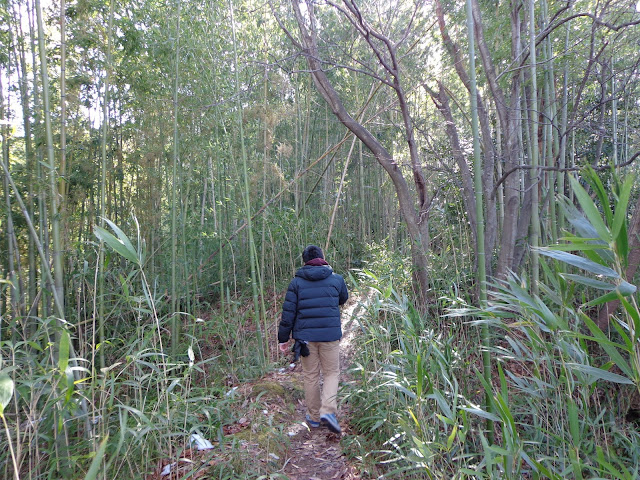
Jeric hiking through a bamboo grove that was along the path to the top.

View from the top of the mountain, overlooking the city of Hikone, some other mountain in the distance, and then Lake Biwa to the right. 
Once the mountain had been conquered, we met up with our friends and just spent the rest of the day hanging out with them and biking around more of the city. By the time we got home it was around 11 at night, and we were absolutely wiped out from the most physically active day that I've had in a good long time, but it was a ton of fun, and all the exercise got me really excited to start skiing soon.

Our last day there was equivalently busy, it just involved less biking. That day I had made plans with one of our friends to get lunch with her old host family, because through a happenstance I ended up Skyping with them once and they wanted to meet me. They were really cool and very nice, and I had a great time meeting them. In many ways they were very different from my host family, but you can definitely see the same cultural background that they all share. It's definitely got both good and bad parts, but regardless it's interesting how much of a person's foundation comes from their cultural setting.

After that we met all met up and went to an event hosted by the the Japanese cultural exchange club at one of the local universities (by local I mean it was only 45 minutes away). Upon coming to Japan, we were told that Waseda is one of the top private universities in the country. Granted, it's nice to hear that, but honestly I never held that much stock in it, I mean everybody knows about it, but everybody knows about all the universities here. It wasn't until that event that I realized how true it was though. When I first mentioned to somebody that I was a study abroad student at Waseda, all of the Japanese students in the immediate vicinity let out a synchronized "WHOA!". Needless to say, for the sake of preserving social balance I began saying that I was just studying abroad in Tokyo. Apparently, going to a rural college and saying that you are a student at Waseda is roughly equivalent to saying that you are a law student at Harvard and cure cancer in your free time. With Japanese universities, it seems like it really is the name that matters most. Once I caught on though and people got over the whole Waseda thing, I had a great time meeting all of the students there and mingling.

I ended off the night by going to Kyoto to meet up with a friend who is studying there, as well as an old TA of ours. It was nice to catch up with them, and we ended up doing karaoke which is always fun, not mention the fact that I realized I can actually crank out a good amount of songs in Japanese now.

Overall it was a great little vacation to cap off the end of the semester. It was fun to see old friends, make some new ones, and see a part of Japan that I had yet to explore.